GAfix.ai8 min read
Turning a GA4 audit into something small businesses can act on
- Role
- Founding Design Lead
- Company
- GAfix.ai
- Timeline
- 2025 – present
- Team
- Lead 2 UI/UX designers, working with the frontend, backend and GA4 teams
- Owned
- Product direction, user experience, marketing and positioning
Summary
We built GAfix to help small businesses identify problems with their Google Analytics 4 setup, assuming they would want to fix those issues themselves. But after around 3,000 audits in the first year, only about 30 customers had paid. I led research with approximately 150 users, challenged our original assumption, and helped reposition the product around an audit that connects users to expert support. The redesign went live in September 2026. Consultation bookings rose from 1–2 a month to around 10 in its first month and 15 in October, a promising early signal but not yet proof of sustained growth.
- 1–2 → 15
- consultations a month, before the pivot vs. October 2026
- ~3,500
- audits to date
- 8
- retainers to date
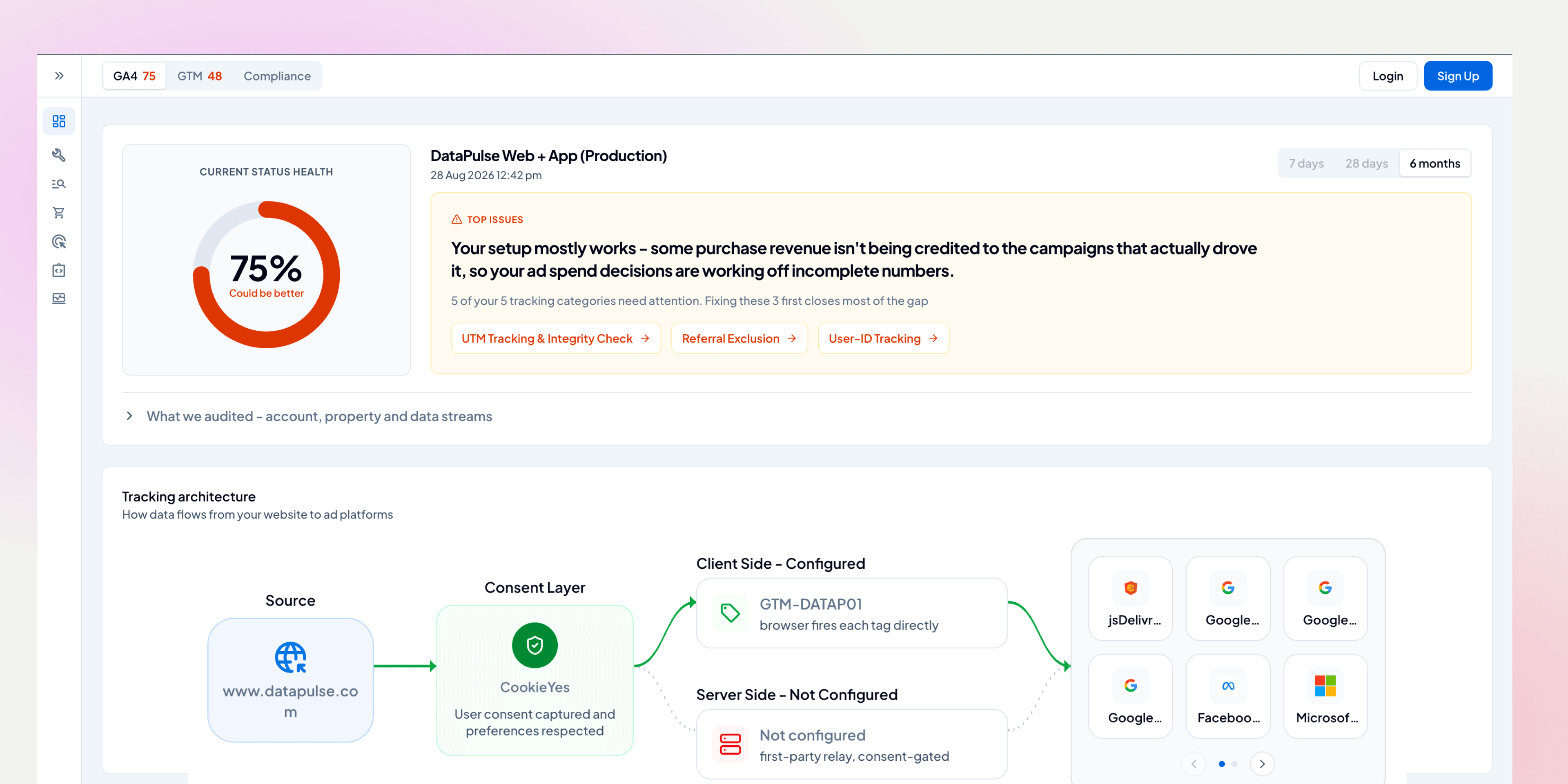
The data loss that started this
When we launched Mokkup.ai at NeenOpal, we thought our analytics were set up as well as possible. Once we started running ads in 2025, we realized something was wrong: users coming from ads weren't being attributed to them. We raised it with our newly hired GA4 experts. It took them a week to debug and almost a month to fix the setup gaps. That meant a month of incorrectly tracked users, ads having to be paused, and lost revenue.
Launching any product means you need an accurate setup in a reporting tool like Google Analytics 4 to understand who your users are, where they come from, and what they spend their time on. Without it, you can't target ads accurately. We knew that, and we still got it wrong, with experts on the payroll.
That sparked the idea for GAfix. If we could get it wrong, so could plenty of small businesses trying to navigate Google Analytics without access to experts. The founders at NeenOpal, the GA4 team and I discussed whether a tool could find these issues for users and give them a prioritized list of fixes, with each issue's severity.
What I own
The GA4 specialists own the audit truth. They decide what gets checked, how severity is scored, and what counts as a misconfiguration. I don't write those rules, and I couldn't.
I own how that truth becomes a product: what users see, how they understand it, where we ask them to act, and how the experience connects to the business model.
The GA team sets the feature list and timelines. I work with them on product direction and on how we can better serve end users. I also lead the two UI designers who handle the core flows, alongside the design and content team members who position and market the product.
Building the product
I started by analyzing competitors to understand what they did well, what they were missing, and where we could build our USP. The UI designers on my team ran the research alongside the GA4 experts.
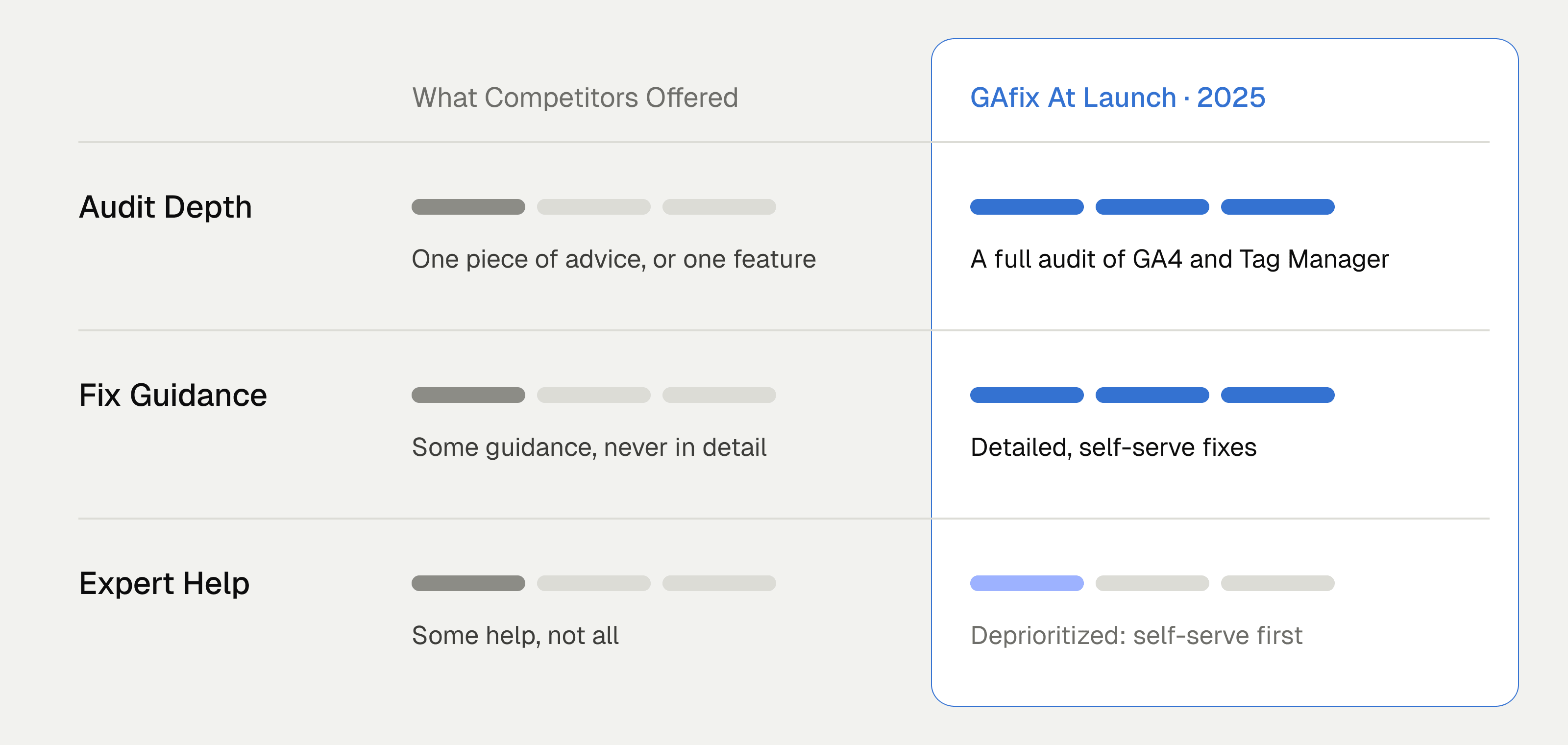
Three gaps came out of it, and they shaped the bet I made.
A comprehensive audit
Most of the tools we reviewed offered one piece of advice or targeted one specific feature. None of them did a full deep dive into every issue in the Google Analytics or Google Tag Manager setup.
Guiding users on fixes
Competitors showed users their issues, and all had some form of guidance, but none of it went into real detail. Detailed, self-serve fixes, thorough enough that a user wouldn't need anyone else, were the part I believed we could own.
Tying in expert services
For users with complex issues, there needed to be a way to connect with one of our GA4 experts. But we made this a lower priority. After discussing it with the GA team, we decided the product should be self-serve, because that was where we believed our differentiation was.
We used these three ideas as the basis for the MVP and launched the first version of GAfix in September 2025, positioned around a comprehensive audit with self-serve guidance.
What we thought vs. reality
From launch, we kept adding features and checkpoints, giving users more. But we weren't converting: around 3,000 audits run in the first year, and around 30 paying customers.
We started investigating with the data we'd collected over the year. I went through product analytics, session recordings, sign-up demographics and user feedback.
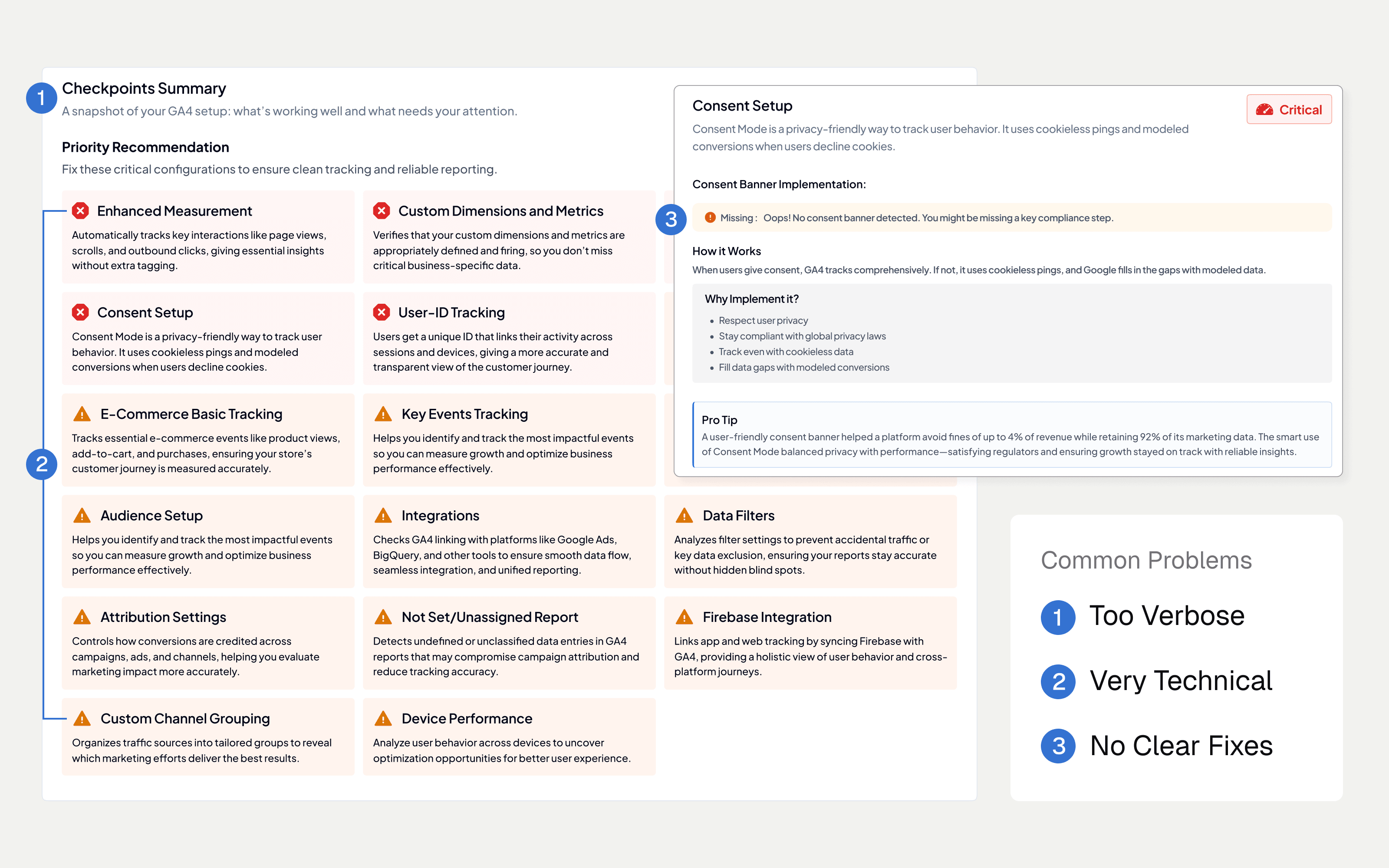
Patterns emerged. Users wouldn't move beyond the summary. They found the report verbose and confusing. They didn't know where to start fixing the issues, especially the ones that needed a developer.
That made us pause. Did we make the right choice in giving users everything up front? Were they getting information overload? Were they even looking for an audit?
We invited users by email, and over two months the GA team and I spoke directly with about 150 of them, by email or call. We deliberately sampled across three behaviors: paying customers, users who reached the payment page and backed out, and users who stopped at the audit summary.
What we learned from the users we spoke to:
- had someone else set up their GA4 property and now didn't know how to navigate it
- ~75%
- wanted someone else to fix their property rather than doing it themselves
- ~90%
- had followed AI suggestions to set up the property and got a different answer each time
- ~35%
That third finding reframed the other two.
We had built the self-serve product because no competitor was doing detailed guidance, and I believed that gap was our differentiator. The research showed that the gap existed because our audience didn't want to be the one doing the fixing. The feature we deprioritized at MVP is now the product.
The pivot
The research changed what I thought the product was for.
- Before: audit → read the full report → work out what it means → fix it yourself
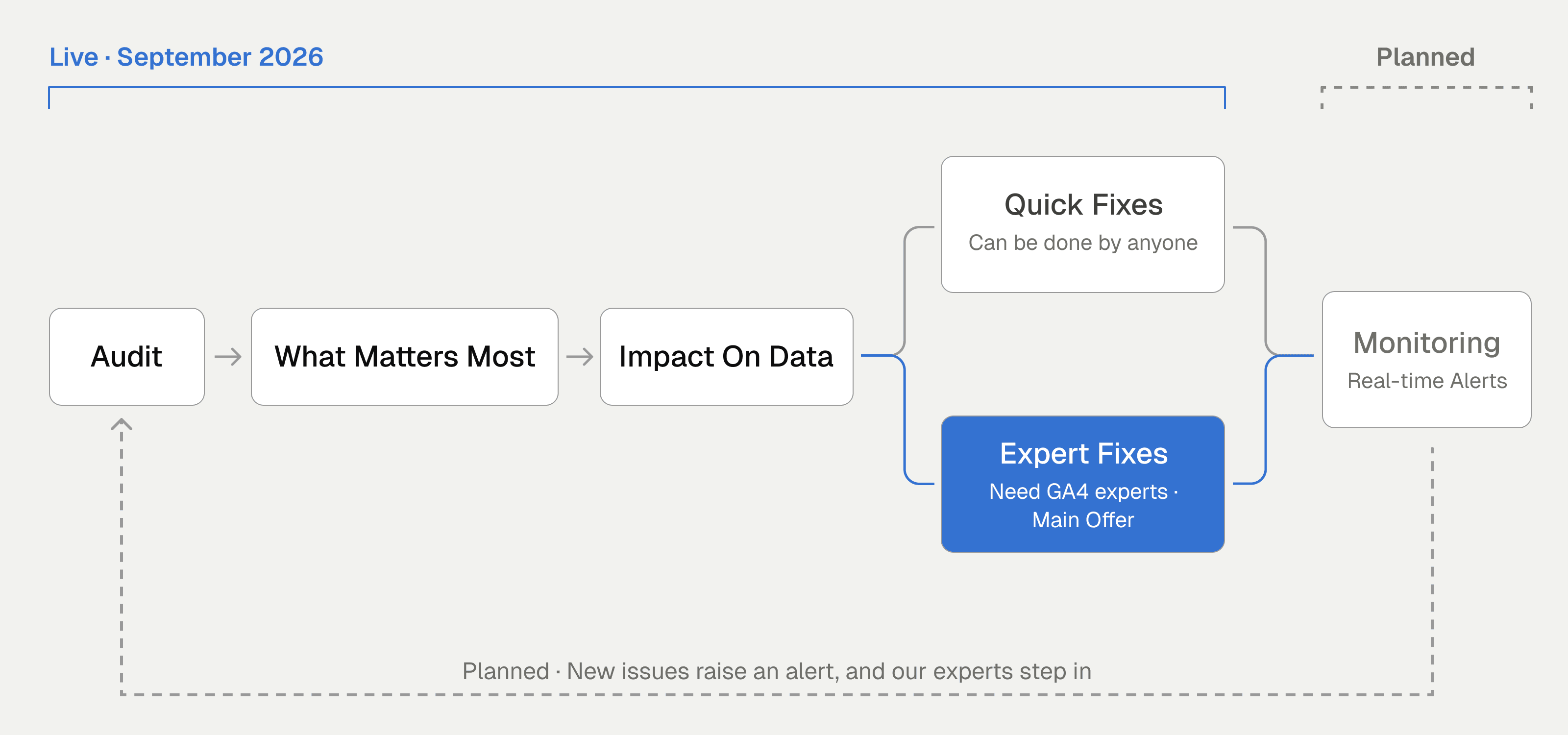
- After: audit → see what matters most → understand the impact → quick fix or expert fix → ongoing monitoring (launching soon)
I took this to the GA team. They took it from there on the service side; I own how the audit gets presented.
That changed the business model first, and everything downstream of it followed: what the report leads with, how fixes are sorted, and where the expert offer appears. Here's what each of the three original gaps became.
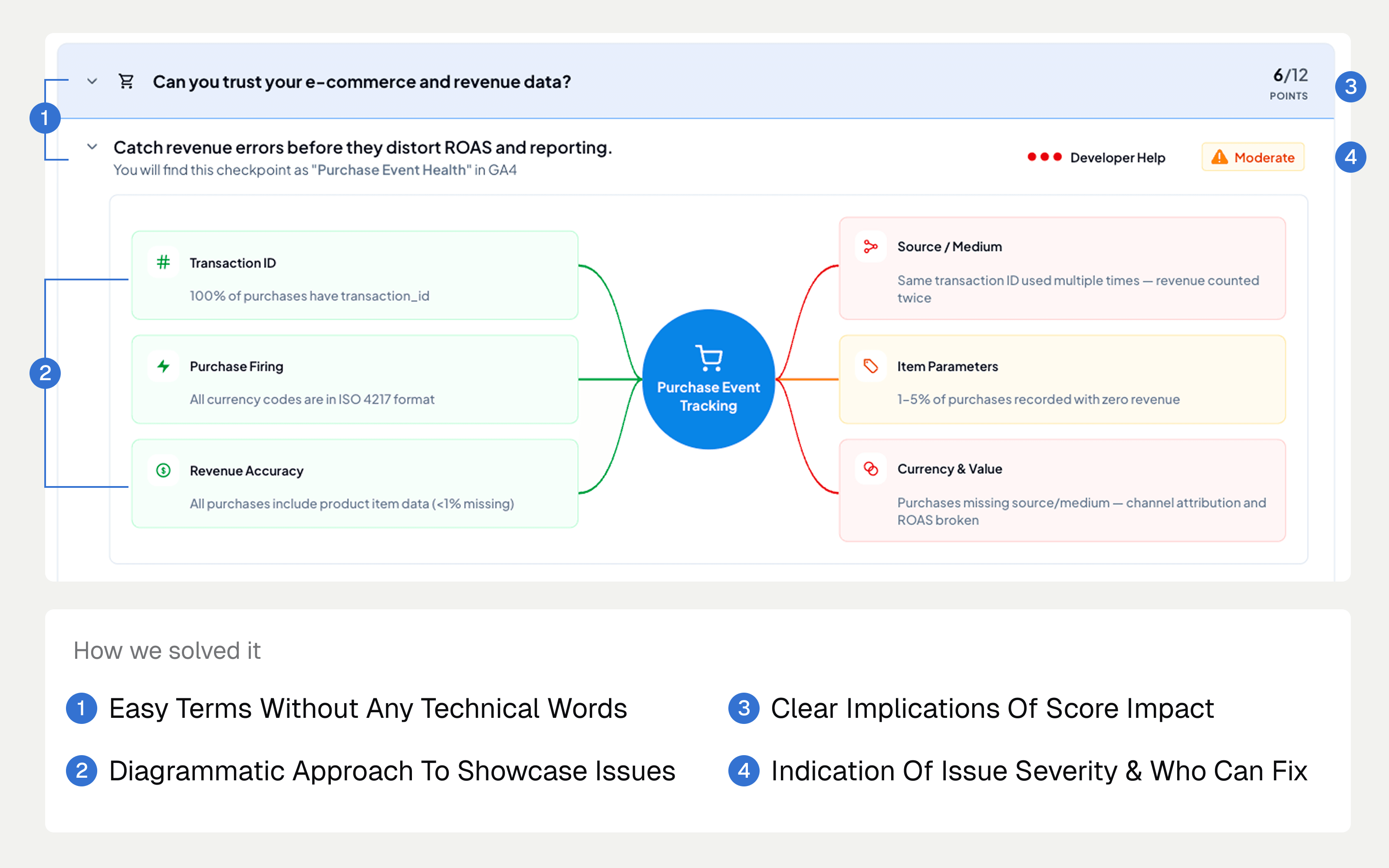
A comprehensive audit, but visual
This is the piece I worked on most closely with the GA team: presenting each checkpoint visually rather than as text. Every checkpoint from the original audit stayed, because coverage was never the problem. But the detail moved behind the summary, as something a user opens rather than something they have to read through.
We also replaced technical jargon with language users recognize. Instead of a checkpoint called "attribution channels," it's "Which channels drive most conversions?"
The relaunch also restructured the audit into three tabs: GA4, Google Tag Manager and Compliance. GTM had been a separate tab before, and compliance used to sit inside the GA4 audit, where consent problems were getting lost among the other checks. Because they carry legal implications, users needed to see them clearly, so compliance now has its own tab. I helped guide the design of all three, and each leads with questions in plain language and a severity, like "Is your tracking compliant, or quietly costing you data too?"
Guiding users on fixes, but simplified
If users don't know what their property looks like, they can't fix it. So we separated quick fixes from the ones that need a developer or an expert. Some checkpoints are simple toggles. Surfacing those first gives users something they can finish in five minutes, an easy win before they reach the harder ones.
Tying in expert services, but now the main offer
This was the most eye-opening finding. Around 90% wanted someone else to fix their property. Several also asked about a monthly arrangement so they never had to worry about GA4 breaking again. At least five of our roughly 30 paying customers had already signed a monthly retainer, while the product was still built around fixing things yourself.
It's the biggest of the three changes. GAfix is no longer an audit tool on its own: the audit identifies what's wrong, and our services fix it.
The next piece turns that into an ongoing relationship. We're launching monitoring soon: GAfix will alert users when new issues appear, whether from a change in their site's development or something else, and we can step in to fix them. That makes the product something users keep, not something they run once.
How we'll know the pivot worked
The redesigned product went live in September 2026, and now we're watching behavior. Are users going through the full report? How many open the deep dive? And most importantly, how many come to us for paid expert services? We'll act as soon as we have data rather than waiting a year.
The first signals are encouraging. Before the redesign, we booked one or two consultations a month. In the first month after it went live, we booked about 10, and in October, 15. Three more customers have signed monthly retainers since the relaunch, bringing the total to eight. Two months isn't a trend, and some of that may be launch attention, so I'm treating it as a strong early signal rather than proof.
- consultations booked a month: before the redesign, its first month live, and October
- 1–2 → ~10 → 15
- customers on a monthly retainer, before the relaunch vs. now
- 5 → 8
What I'm watching for specifically is the case where the numbers don't move. If users still don't convert with a visual, prioritized, plain-language report in front of them, then verbosity was never the real problem. The diagnosis was wrong, not the execution. I'd then look at two other explanations: missing trust signals that stop users from paying, or users still not grasping how serious these issues are and why they need fixing, especially if they're running ads.